Consultoría de ingeniería de software y observabilidad
Ingeniería de software y observabilidad cloud
Un equipo senior en infraestructura crítica, haciendo que las operaciones tecnológicas cuesten menos y fallen menos: observabilidad, SRE, performance y FinOps sobre AWS, GCP y Azure.
Programas para startups
Somos parte de los programas para startups de Google Cloud, AWS y Microsoft
- Google Cloud Google for Startups Cloud Program
- Amazon Web Services AWS Activate
-
Se paga de más y no hay quién lo resuelva
El síntoma que llega siempre es el mismo: servidores sobredimensionados, aplicaciones lentas, incidentes que se repiten y nadie que pueda decir cuánto se está pagando ni por qué.
de sobregasto promedio en infraestructura cloud en las empresas en Chile.
de desperdicio anual en la nube a nivel global, según estudios de Flexera.
la demanda de ingenieros de observabilidad y FinOps supera de largo la oferta local.
Nuestro producto
Moonin, observabilidad operativa para Kubernetes
Ese diagnóstico lo hicimos tantas veces que lo convertimos en producto. Moonin responde qué cambió en un cluster, qué está afectado y cuál es el siguiente paso. Un solo Helm chart, trazas con eBPF y sin instrumentar código.
- Inventario continuo de recursos, despliegues y eventos
- Historial de revisiones con imagen, commit y duración
- Métricas DORA desde el historial del propio cluster
- Compatible con EKS, GKE, AKS y clusters autoadministrados
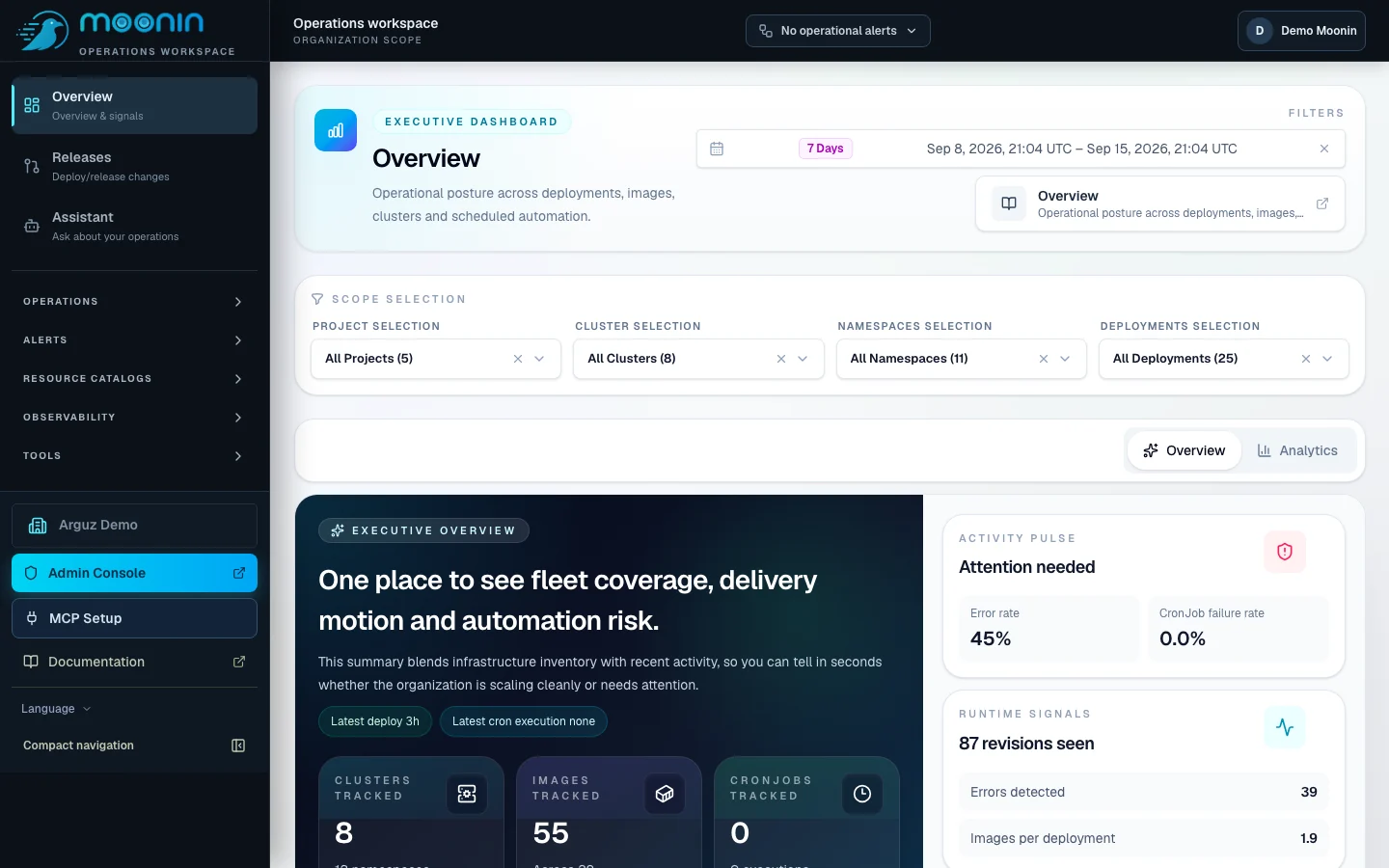
La demo es pública y sin formulario: usuario demo@moonin.app, contraseña demo123. Es un entorno compartido con datos de ejemplo.
Qué hacemos
Tres frentes que se suelen contratar juntos, porque un sistema lento y un sistema caro casi siempre son el mismo sistema.
Desarrollo de software
Vibe Coding
Desarrollo asistido por IA donde la velocidad no compromete la calidad: generación de código con validación continua, testing automatizado y entrega incremental. Cada línea pasa por revisión humana experta antes de producción.
Spec-Driven Development
Arquitectura primero: especificaciones claras, contratos API-first y documentación como código antes de escribir implementación. Menos retrabajo y menos deuda técnica desde el día uno.
Site Reliability Engineering
SLO y SLI, error budgets, reducción de toil, gestión de incidentes y postmortems sin culpa. Construimos la cultura y las herramientas para operar con confianza a escala.
Observabilidad
Métricas, logs y trazas distribuidas con OpenTelemetry, dashboards operacionales, alertas con control de ruido y correlación de eventos para entender el sistema en tiempo real.
Operaciones y performance
Performance aplicativa
Cuellos de botella con profiling avanzado, optimización de queries y menos latencia en APIs críticas. Análisis de concurrencia, fugas de memoria y optimización de I/O para alto tráfico.
Optimización de ambientes
Rightsizing con datos reales de consumo, no con estimaciones. Tuning de infraestructura, eliminación de recursos ociosos y auto-scaling que responde a la demanda real.
Estabilización
Reducción sistemática de incidentes con análisis de causa raíz, circuit breakers, políticas de reintento y health checks, para sistemas que se recuperan solos y degradan sin caerse.
Debugging avanzado
Los problemas que nadie encuentra: race conditions, deadlocks, corrupción de memoria y fallas intermitentes. Tracing distribuido, flame graphs y análisis de dumps hasta la raíz.
Migración a la nube
Desde on-premise o entre clouds: assessment de workloads, estrategia lift-and-shift o re-arquitectura, migración de datos sin ventana de caída y validación posterior completa.
Hardening y seguridad
Revisión de configuraciones, políticas de red, gestión de secretos, escaneo de vulnerabilidades en contenedores y cumplimiento de estándares para ambientes productivos.
Inteligencia operacional
FinOps
Visibilidad total del gasto con asignación por equipo, proyecto y servicio. Detección proactiva de anomalías de costo, optimización de instancias reservadas y gobernanza multi-cloud.
Automatización con agentes
Agentes que monitorean, diagnostican y resuelven: desde alertas que se remedian solas hasta pipelines que se autocorrigen. Integrados a PagerDuty, Slack y Jira, con flujos propios en n8n.
Qué obtiene el cliente
de reducción en la factura cloud.
menos incidentes en producción.
remoto, donde esté el cliente.
Cifras medidas por Arguz en sus propios proyectos. El resultado depende del punto de partida: un ambiente ya optimizado deja menos margen que uno que nunca se revisó.
Con qué trabajamos
Cloud e infraestructura
Datos y desarrollo
IA y automatización
Preguntas frecuentes
Las respuestas cortas. Lo demás, escríbenos.
¿Qué hace exactamente Arguz?
Arguz es una empresa de ingeniería de software y observabilidad cloud con sede en Santiago de Chile, que trabaja 100% remoto. Tiene tres frentes: desarrollo de software (incluyendo SRE y observabilidad con OpenTelemetry), operaciones y performance (profiling, rightsizing, estabilización, debugging, migración cloud, hardening), e inteligencia operacional (FinOps y automatización con agentes).
¿Cómo cobran?
Por proyecto, con alcance definido después de una primera conversación. No hay lista de precios publicada porque una estabilización sobre tres clusters y una migración cloud de una plataforma heredada no tienen nada en común. La primera conversación no cuesta y termina con un alcance y una cifra.
¿Cuánto se puede reducir realmente una factura cloud?
Hasta 40%, medido en proyectos propios de Arguz. Depende por completo del punto de partida: el ahorro viene de capacidad declarada que nadie usa (réplicas de más, requests sobredimensionados, recursos corriendo sin dueño), así que un ambiente ya revisado deja menos margen que uno que nunca se miró.
¿Trabajan con empresas fuera de Chile?
Sí. La operación es 100% remota y se trabaja en América Latina. El huso es GMT-3 o GMT-4 según la temporada, que se superpone con casi todo el continente y con la costa este de Estados Unidos.
¿Necesitan acceso a los sistemas de producción?
Para el diagnóstico suele bastar acceso de lectura: métricas, logs, configuración de los clusters y la consola de facturación de la nube. Se firma un acuerdo de no divulgación antes de tocar nada, y cualquier cambio se propone y se aprueba antes de aplicarse.
¿Qué relación hay entre Arguz y Moonin?
Moonin es un producto de Arguz, no una empresa aparte. Salió del trabajo con clientes: la plataforma responde las mismas preguntas que se contestaban a mano durante los incidentes. Se pueden contratar los servicios de ingeniería sin el producto, y usar el producto sin ellos.
Quiénes somos
Arguz SpA es una empresa de ingeniería joven, fundada por tres socios con carrera combinados operando sistemas críticos.



Contacto consultivo
Cuéntanos qué estás operando
Miramos tu infraestructura, dimensionamos el sobregasto y definimos un plan, sin compromiso inicial. Respondemos dentro de un día hábil.
Santiago de Chile — operación remota (GMT-3 / GMT-4)
Confidencialidad garantizada. Firmamos un acuerdo de no divulgación antes de acceder a métricas o repositorios.